Mentor Teacher Support (Case Study 2)
Mentor Teacher Support (Case Study 2)
Raising Texas Teachers is a Charles Butt Foundation initiative aims to improve the status of the teaching profession by enhancing the recruitment of a talented and diverse teacher workforce through the Charles Butt Scholarship for Aspiring Teachers, supporting retention of teachers in the classroom, and partnering with university-based teacher preparation programs to raise the overall quality of teacher preparation across the state by promoting continuous improvement in the field.
Through the Foundation’s partnerships with teacher preparation programs, faculty teams identify common areas for improvement and form cross-university groups called Educator Preparation Program Improvement Communities (EPPICs). Each EPPIC spent two years listening to mentor teachers, teacher candidates, and other stakeholders, testing interventions on their own campuses, and learning from what other universities were finding.
Each EPPIC shared a write-up of their findings. The post below shares what one of these EPPICs discovered. To learn more, click here.
Rethinking Mentor Preparation
From Experience to Impact
Presented By:
University of Texas at Dallas
University of the Incarnate Word
Rice University
Across the University of Texas at Dallas (UT-D), University of the Incarnate Word (UIW), and Rice University (RU), a shared concern kept surfacing: even our most experienced teachers weren’t always equipped to serve as mentor teachers for clinical teacher candidates in consistent, high-quality ways.
Aspiring clinical teachers within the same program were having very different experiences. Some received thoughtful coaching and actionable feedback; others navigated their placements with minimal guidance. In many cases, mentor teachers were assigned by districts and had limited information about university expectations. Meanwhile, the teacher preparation programs often had limited information about the mentor’s preparation for the role of mentor.
Prior to summer 2026, policy requirements from the Texas Education Agency ensured that training existed, but not necessarily that it was meaningful, aligned, or responsive to mentors’ actual needs. In summer 2026, after the conclusion of this EPPIC, TEA debuted new, more rigorous training for mentor teachers.
For the EPPIC, this raised a critical question:
How can we better understand, and then support, the Mentor Teachers who shape our candidates’ day-to-day learning most directly?
Rather than redesigning training from the top down, the EPPIC began by building and administering mentor surveys to ensure any resulting activities were responsive to mentor teacher needs.
Each of our institutions analyzed their own data, but the instrument itself-and the thinking behind it- was shaped collaboratively. This balance of shared design with local adaptation became a defining feature of our work.
What We Learned
Across sites, one finding stood out immediately:
Mentors are strong—but not always in the ways our programs most need.
At RU, mentors demonstrated high confidence in relational skills, particularly emotional support. But they felt less prepared to support candidate engagement and instructional growth.
At UT-D, mentors brought deep classroom experience—often over a decade—but many were unfamiliar with the program’s instructional model or expectations. Even those with prior training still asked for support in coaching and co-teaching.
At UIW, most mentors had received little to no formal training beyond what the educator preparation program provided. However, they were highly receptive to learning, especially when training included:
- Concrete examples (like co-teaching videos)
- Structured collaboration time
- Clear expectations for their role
Across all three institutions, one pattern held: Teaching experience did not equal preparedness for mentoring.
The Power and limits of training
As programs began to respond to survey data, promising practices emerged.
Training that worked well tended to:
- Be practical and role-specific, not abstract
- Include time for co-planning and relationship building
- Provide shared language and models (like co-teaching frameworks)
- Bring mentors and candidates together for joint learning experiences
Programs wrestled with how to:
- Support mentors with widely varying levels of prior experience
- Ensure consistent implementation of co-teaching and coaching practices
- Build time into already full schedules
- Maintain momentum amid staffing and partnership changes
Even something as straightforward as administering a survey proved complex—requiring clear communication, aligned timing, and shared understanding across teams.
Lessons learned
Looking across our work, a few lessons rise to the surface:
- Don’t assume strong teachers are ready to mentor.
Mentoring requires a distinct skill set, one that must be explicitly developed. - Start with data, not assumptions.
Understanding who your mentors are and what they need creates a far stronger foundation for training. - Avoid one-size-fits-all approaches.
Mentors benefit from scaffolded support that meets them where they are. - Prioritize clarity and communication.
Clear expectations, timelines, and ongoing touchpoints make a measurable difference. - Make time for the work that matters.
Relationship-building, reflection, and co-planning aren’t extras—they’re essential.
We [Educator Preparation Programs] throw them into this scenario, and they have to be able to mesh and launch their relationship quickly. And they don’t have time.
Looking Ahead: Building More Coherent Systems of Support
Across institutions, we are:
- Revising mentor training to focus on role clarity, engagement strategies, and candidate independence
- Creating more consistent communication structures, including onboarding materials and regular check-ins
- Exploring ways to track and make visible mentoring practices like coaching and co-teaching
At the same time, bigger questions remain—especially around partnership:
How can EPPs work more closely with districts to influence who becomes a mentor and how they are prepared?
For smaller programs in particular, this remains both a challenge and an opportunity.
Key takeaway
Effective mentoring depends on alignment.
When expectations, training, and communication are clear and connected, even experienced teachers become more effective mentors, and teacher candidates benefit in powerful ways.
Resources
Each university created a one-pager outlining their work.

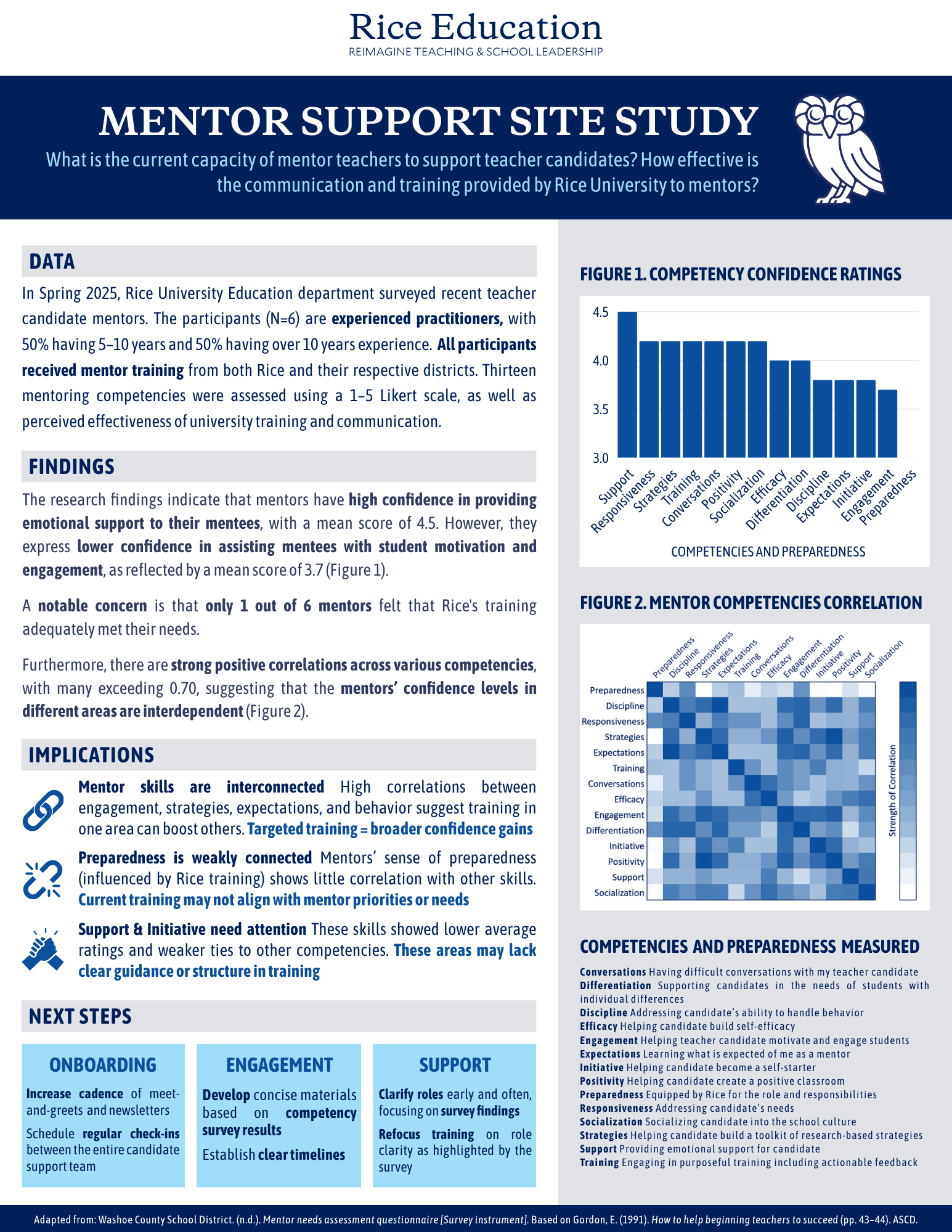
Additionally, the team created a presentation overview of their work and findings

Program contact information:

Thea Ulrich-Lewis
Vice President of Programs
Other statewide programs


